Riding the Big Waves: Dr. Lawrence Souza on the Economy and Bay Area Real Estate
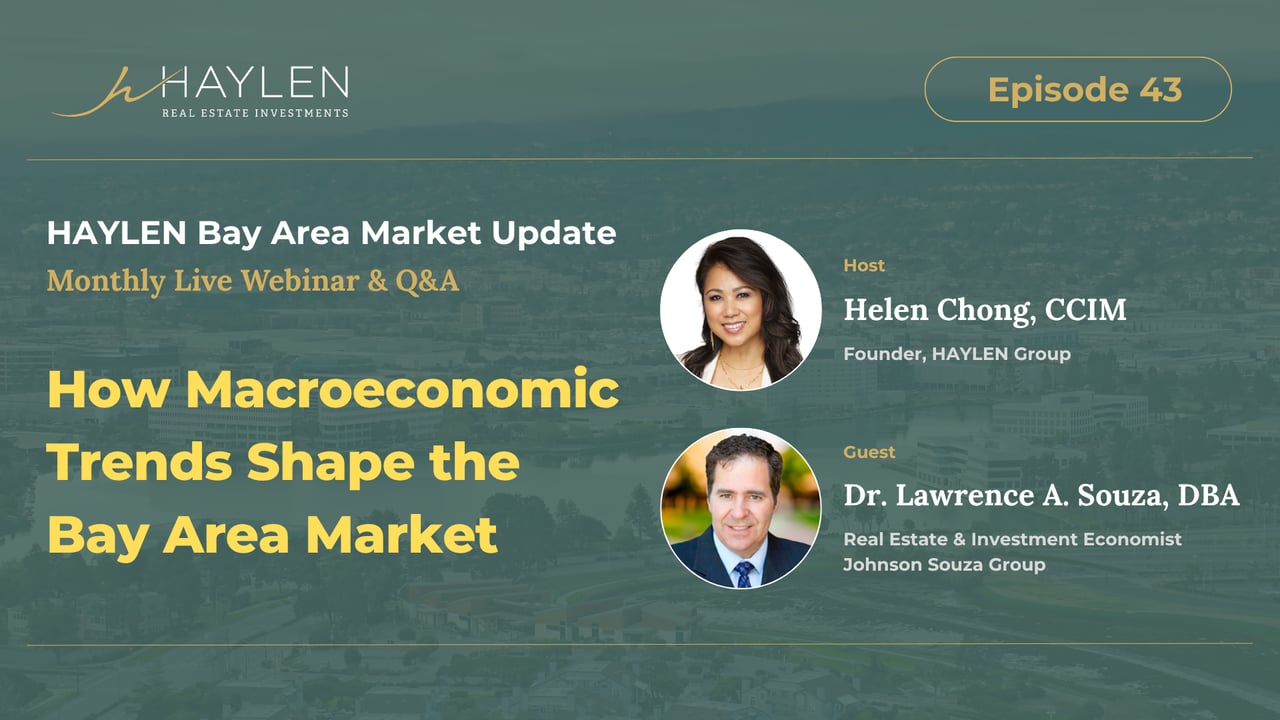
For our June HAYLEN Bay Area Market Update, we were honored to host Dr. Lawrence Souza, who brings 30 years of experience in the commercial real estate industry. He holds a DBA — a Doctor of Business Administration — along with the CRE, RICS, and CCIM designations, among the most prestigious and difficult to earn in the field. He's a senior investment advisor, financial services advisor, economist, broker, consultant, and an adjunct professor. Below are the takeaways from his presentation, in his own words. Watch the video recording here.
A note up front, in Dr. Souza's words: he is not giving tax or legal advice. For tax or legal questions, seek out a professional attorney and a tax accountant. As a financial advisor he can do financial and tax advising, but not tax and legal advice, because he is not a licensed CPA or an attorney.
Real estate investing — and especially the economy right now — is like riding big waves. You've got to be fit, you've got to practice, you've got to train, you've got to be constantly learning, and you've got to be ready for the big wave. If you're ready, you're going to ride it. If you get taken out, you shake it off, get back out there, and do it again.
Efficient real estate and securities capital markets require strong public- and private-sector cooperation, disclosure of government and corporate financial conditions, and both institutional and individual investor confidence in our financial and political institutions.
The key point in analyzing the markets today is that you have to understand what's going on politically — geopolitically on a global basis, nationally, at the state level, and at the local level. Political outcomes determine policy outcomes, and policy outcomes determine the effect on the economy and on the real estate markets.
To really understand how value is created, Dr. Souza described the integrated framework he built early in his career: you have to understand managerial and financial accounting; finance and capital markets; monetary and fiscal policy; and politics, which becomes law, which is administered through the bureaucracy — along with the intended and unintended outcomes. When you go overseas and do comparative analysis, you also have to look at the philosophy and theology of those countries. It's multi-institutional and multidisciplinary. If you can understand how all of these work together to determine the value of real estate, the stock market, the bond market, and your own human capital, you'll understand how the world works and be able to make decisions more decisively. And if you can't do that, you hire people like Dr. Souza and HAYLEN to help guide you through the volatility.
The shocks reshaping the system. Over the last 12–13 years — since the financial crisis, and then COVID, 9/11 before that, the tariffs, and now the war — we've experienced a series of existential shocks that are rearranging the institutional relationships between governments and their citizens, governments and corporations, and corporations and their customers. Long-term and institutional investors looking out 10, 20, 30, or 40 years have to understand these shifts in order to reallocate and protect their capital. Many of us won't live another 40 years, but our kids and grandkids will — so the question is whether we're making the best decisions not only for ourselves, but for our kids, our grandkids, and our great-great-grandkids.
To judge whether values are rising or falling, Dr. Souza uses the income capitalization model — the discounted cash flow model. If rents are rising, your NOI goes up and your values go up. But if rents are rising while expenses rise faster, your NOI goes down — and that's one of the issues right now. Rents are going up, but expenses are going up faster, so NOI can be flat or declining, which holds values constant or puts downward pressure on them. Couple flat or declining NOI with rising inflation, interest rates, and cap rates, and you get value declines — and we've already lived through that.
He pointed back to the cycle Helen described: after the COVID crisis, rising rates and inflation hit the housing market hard. Up until the January before the election, rates and inflation were starting to come down and economic activity was picking up. Then the tariffs shocked the system — and that showed up in prices, demand, values, and interest rates. The tariff shock, combined with higher post-COVID inflation, pushed rates up significantly. Everything was getting into the sweet spot right before January 2025; then came the tariffs (the first shock), followed by the conflict in the Middle East and the disruption of the straits. Now we're seeing inflation around 4–5% and rates rising again. Europe raised rates, and based on current inflation — which may not even reflect all the true inflation — the new Fed chair will likely either hold rates steady or have to raise them, because market interest rates have moved higher than the Federal Reserve's rates. That means the Fed is accommodative and will have to react.
His bottom line: the volatility in valuations over the next 12 to 24 months isn't coming from the demand side or NOI — it's coming from higher discount rates and higher cap rates reflected in the market. When you build those cap rates and discount rates, you have to account for inflation, credit-risk premiums, illiquidity, maturity fluctuations, potentially higher taxes from the debt and deficit, and — importantly — the political and policy risk premiums we largely assumed away over the last 30 years. Those premiums have now become institutionalized, and institutional investors are actively analyzing geopolitical risk and adding it to their discount rates and expected returns, which makes valuation volatility harder to predict.
There's more systematic risk in the market today — more market risk, political risk, and structural risk. The only way to bring systematic risk down is to focus on your business, your portfolio, your family, and your clients — on technology and products, and on bringing the best product to market.
Dr. Souza pointed to the 80/20 rule: focus on the 20 best clients who generate 80% of your revenue. Do the best job you can and grow your revenue first with your existing clients; then offer more products and services to grow further; and only then go prospect for new clients or create new products. Those are the first things to focus on to immunize yourself from market risk.
As an illustration of what to consider over the next 30 to 40 years — recognizing that with advancing medical technology, today's 20-year-olds may live to 120 — Dr. Souza shared an example portfolio:
40% bonds (he'd lean toward higher-quality corporate bonds)
25% stocks
10% cash-value mutual life insurance
Direct equity real estate — both residential and commercial
Alternative assets such as gold and energy
Digital assets — some crypto, possibly hedged
Looking forward, he expects tokenized real estate to become an option — something he wrote a paper on four years ago and expects to materialize within the next two to four years.
The Bay Area, and really the whole Pacific Northwest including Seattle and Portland, benefits from facing Asia. The San Francisco Bay Area absorbs a great deal of physical and human capital from Asia — home to some of the fastest-growing economies in the world. And Southern California, particularly the ports of LA and Long Beach, handles up to 40–50% of gross trade flows, moving through the Alameda Corridor out to the Inland Empire.
So California is a core strategy — a great place to build your wealth. When you're ready to diversify geographically, you can spin off part of the portfolio with a 1031 exchange into markets like Scottsdale or select submarkets in the western region. The discipline is to pick your submarkets, then pick your neighborhoods — the ones with the best economy, labor, capital, real estate, education, healthcare, and transportation networks. Do that, and you'll be fine.
He also offered a different lens on geography: invest by transportation arterials — the routes where goods and services are transported and distributed across the country. Prologis recognized this strategy back in the early 1990s and grew from a $4 billion company to over $400 billion in market cap within 20–25 years.
Get as close in as you can. California has the highest concentration of tech companies, and the Bay Area and Southern California have the highest concentrations and population density. If you go out into the interiors, you take on supply risk — land is cheaper and cap rates are higher, but you may not have the demographic or economic base to support occupancy. Silicon Valley was the sweet spot — the goose that laid the golden egg — and now that footprint has expanded up the 101, the 280, the 580, and the 680, with high concentrations of tech in San Francisco and biotech and biopharma in San Mateo.
He framed his market map in tiers: the core markets — Class A submarkets — performed best; then Class A and B+ markets; then the commodity markets further out. There are pockets everywhere — Dublin, Fremont, San Ramon, Pleasanton, Alamo, Danville; on the Peninsula, San Mateo, Redwood City, Atherton, Menlo Park, Palo Alto, and Mountain View are core because of Stanford; and South San Francisco is core because of Genentech and the airport. The markets in the upper right of his scoring are more expensive but preserve their value; the lower-left markets are your opportunistic plays.
Follow the economic base. When you buy a property, ask what economic base is driving the demand for employment and underwriting the demographics and socioeconomics of that area. Ask which industries are expanding and which are contracting. We're all getting older, so healthcare is a good place to be. And despite the current politics around science and universities, Dr. Souza believes research institutions and universities will continue to be growth poles in the long run — UCSF, Davis, Berkeley, Stanford. San Francisco is going through an AI boom right now that's also bringing in lawyers, accountants, and other ancillary services. He pointed to telecom and media in LA, the internet and AI in the city, trade and tourism in LA, and education and government services in Sacramento (he likes Folsom, downtown Sacramento, and Davis). Diversify geographically — but also by economic base, industry, and the major employers providing your tenants. As for rent control, he called it a two-edged sword.
We've watched rising interest rates as the Fed's balance sheet hit $9 trillion and began coming down — the Fed selling off its balance sheet, driving bond prices down and rates up. The big question now is how the Federal Reserve and the new Fed chair deal with $40 trillion in debt outstanding and $2 trillion in deficit financing. Who buys that paper — pension funds, banks, international sovereign funds? Foreign buyers like the Japanese and Chinese will continue to buy U.S. Treasury securities — in part to bid up the dollar and keep their own currencies competitive for exports — but the question remains: with $40 trillion outstanding and $2 trillion that needs to be financed at higher rates, how do we pay for it?
There are essentially three paths: raise taxes, grow the economy, or — the worst option, and the one Dr. Souza believes we're living through — create inflation to monetize the debt. In his view, the Fed has done a poor job controlling inflation over the last several decades and is now allowing inflation to run harder, faster, and longer to monetize the debt. That may help the government, but it hurts the lower half of the income spectrum, because purchasing power gets inflated away — which is exactly why affordability is one of the biggest issues heading into the 2026 and 2028 elections.
The yield curve. Nearly everything — debt, equities, mortgage rates, student loans, car loans — is priced off the yield curve, anchored to the 10-year Treasury. At the beginning of the year the curve was inverted, predicting a significant slowdown. Now it's upward sloping but flattened and only slightly upward — the market expects inflation to continue, driven by aggregate demand. The market has been selling off bonds and the Treasury has been selling short-term bonds, driving prices down and rates up. Dr. Souza forecasts the curve will stay slightly upward sloping but shift up as inflation works through to the consumer and producer side. He doesn't see inflation or rates coming down soon, and believes the Fed actually needs to raise rates to bring its rate up to where market rates already are — meaning the Fed is currently over-accommodative.
He was blunt on one point: inflation is never good.
The Fed and the Treasury. Looking at the Fed's balance sheet, 64% of the securities are U.S. Treasury securities. In his reading of history, the Federal Reserve has always functioned as an arm of the Treasury — it buys our debt, and if the Treasury issues too much, the Fed continues to print money and absorb some of that deficit financing.
Money supply and velocity. Historically, money-supply growth tracked GDP, with the Fed growing the supply by roughly 5% a year to create moderate inflation — because our system operates on mild inflation, not hyperinflation. He'd argue the bouts of inflation after COVID, and what we're seeing now, edge toward hyperinflation that few are naming. He also pointed to the velocity of money — the number of times money circulates in the economy — which collapsed during COVID, recovered, and is now tapering off, a signal that the economy is starting to slow. It's a really important indicator to watch.
Inflation versus target. Inflation is running around 4.2% against the Fed's 2% target — roughly double. If the Fed were doing its job, it would raise rates to cool demand and bring inflation down, but there's pressure in the other direction. So watch what the Fed does, because it has a direct impact on the cost of money.
When Helen asked where rates would need to go to keep inflation under control, Dr. Souza's view was to hold the 10-, 20-, and 30-year maturities around 5%, with short-term rates closer to 3%. The trigger point matters: once long-term yields breach 5% yield-to-maturity, investors start asking why they should take real estate or stock-market risk when they can lock in a roughly risk-free 5% on the 10-year — and pick up price appreciation on bonds if rates later fall. The catch is that with inflation running 3–4%, the purchasing power of those bond returns erodes. So while bonds may be the safer haven, if you want to take advantage of an inflation pickup, he'd lean toward equities — because firms can pass inflation through to the consumer and maintain their profit margins.
GDP. The economy can handle about 3% GDP growth without inflation. Right now GDP has slowed to around 1.6–2% — not too fast, not too slow. GDP isn't the best measure of activity, but it's the headline number, and at 1.6% it's a reasonable reading.
Payroll. Year over year, the economy generated about 344,000 jobs as of May — a good number. The labor market is bifurcating: there are jobs available, but lower-skilled jobs are getting hit the hardest, while skilled jobs above a certain level are holding up. Employers put off hiring early in the year and appear to be playing catch-up now. The number to watch is whether year-over-year job gains stay above 250,000–300,000 over the next two to three months. Either way, the economy is still growing and still adding jobs.
Unemployment. Anything below 5% is healthy — 3% is frictional and 4% is full employment — so we're still at full employment. Part of the reason is that people have left the labor force, some after COVID and some choosing not to re-skill around AI. Labor participation rates tell a deeper story: about 70% for men versus a 61% average, 57% for women, and roughly 37% for college-age young adults. Participation peaked around 67% and now sits near 60% — and that gap represents lost income. He noted that Congress tends to enact labor policy only during crises, and otherwise focuses elsewhere.
The Bay Area specifically. Net, as of May, the Bay Area added 8,100 jobs. The long-term average over the last 36 years is about 38,000 jobs per year — so we're running about a third of trend. The big question is the trade-off between tech layoffs and job creation. Many of the tech workers being laid off are starting AI-driven businesses, shifting from employee to business owner — which is hard to track. The tech community has done this repeatedly over the last 30 years: when they get hit, they pull their capital together, bring their colleagues in, and start companies. With today's AI tools, building a viable platform is far faster — Dr. Souza's own consulting team now turns around a full management consulting report in two to four weeks, work that used to take two to four months.
The Bay Area's unemployment rate is 3.9% — still below 5%, still one of the tightest labor markets in the country, even tighter in Marin and on the Peninsula. Meanwhile, companies laying off tech workers are redeploying those savings into AI and data-center capital expenditure — which is part of why the stock market has done so well. In his view, we're in the biggest technological CapEx boom since the dot-com era, perhaps since the defense boom of the 1970s and '80s. He sees the Bay Area as ground zero — and expects that once companies like Anthropic, SpaceX, and OpenAI go public, those employees will cash in stock options and start buying homes and investing.
Asked whether there's a glimmer of hope for the housing market, Dr. Souza's answer was: it depends on which market. Cloverdale, Eureka, downtown San Mateo, downtown San Jose, the West Side, Atherton, Menlo Park — they're all different. The core housing markets recover first, and then it broadens out. He pointed to history: after the dot-com boom, the first thing people did with their stock options was buy a great house. Every time something like this happens, the pattern repeats — cash in the options, buy the home.
Helen summed up what may be the most important point of the whole webinar: the Bay Area market has softened, but it's likely to come back — and come back strong. AI has caused job losses temporarily, but many of those people are shifting from employees to running their own payroll.
Dr. Souza also flagged markets to watch — Pleasanton, Hacienda, Bishop Ranch — which are sitting on a lot of obsolete office inventory. Owners there are master-planning: tearing buildings down and creating mixed-use facilities with retail, housing, single-family, and rental. They're in great locations with land and the ability to do it; it may take 10 to 15 years, but the conversations about demolition are already happening.
Data centers have become political, and they're massive. Many of the largest are located further out — in places like Texas — because hyperscale data centers need land, labor, capital, energy, and water. We've seen a major boom, and now some development is moving overseas to access those same resources. Despite political pushback, Dr. Souza expects the data-center build-out cycle to slow somewhat but continue through 2030–2032, with companies raising equity, debt, and private capital because the demand is so high.
He also pointed to a complementary opportunity through his company Greenspark: micro–data centers, where roughly every 1,000 square feet equals one megawatt. He sees essentially infinite demand for micro–data centers — the hyperscalers build out the largest layer, while micro–data centers build out levels 2 and 3 of the internet. There are stranded assets and excess energy capacity sitting idle when businesses shut down and utilities are left with allocated, unused energy. Bringing in micro–data-center operators to absorb that excess capacity generates revenue for the utility and helps hold down rates — a potential solution to some of the hyperscale constraints. They're two different, complementary markets.
Rounding out the national picture, Dr. Souza highlighted the top-performing markets by asset class:
Multifamily: Miami, Nashville, Austin, Dallas, Phoenix — high growth, highest rent growth, and highest occupancy. San Francisco showed retail strength.
Industrial: Savannah, Houston, Atlanta, Chicago, Dallas, Kansas City — the major industrial hubs.
Office: Miami and Orlando lead, followed by New York and San Francisco — with San Jose at number 7.
Hotels: hit hard, but likely to recover somewhat, especially over the summer, after their post-COVID boom.
Life science: also hit hard, with excess supply and less interest post-COVID, made tougher by policies affecting research universities and STEM institutions — even though, in his view, our scientists and graduate students remain a real comparative advantage.
In response to a question, Dr. Souza shared a candid view from 30 years of teaching: too many graduates leave school without a clear sense of the working world, and too many institutions aren't preparing students for jobs. His own approach is hands-on — students build deliverable packages, write memos and reports, build portfolios, and present strategies, making the transition from the academy to the workforce through internships and jobs.
His advice for families: have your kids learn how to work. Look for programs that let them earn a recognized bachelor's degree while they're working, so they're not carrying a quarter- to half-million dollars in debt for a degree that may not lead to a job. Better, he suggested, to use those resources to help them buy a home, or partner with them on real estate they help manage. And if your kids study business and earn their real estate license, they can come work for you — you can use the revenue from your business to pay them a salary and fund their education.
To close, Helen asked Dr. Souza for a single piece of advice for Bay Area families and investors. His answer:
"Find the best people to work with. Don't believe everything everybody tells you. Do your own due diligence. If it looks like too good of a deal, it's too good of a deal. Question everybody's ethics, and question everybody's motivation. Work with the best people who have high ethics and high standards — people you can trust."
It's a fitting note for how we think about real estate at HAYLEN: as a tool for building legacy, guided by data and people you can trust.
We host the Bay Area Market Update webinar on the second Thursday of every month, bringing you the data and expert guests to help you make informed, confident decisions about your real estate.
Save your seat for the next session → www.haylengroup.com/webinar
Stay up to date on the latest real estate trends.


A Bay Area Realtor's approach to schools, neighborhoods, and long-term value for families making a move
You’ve got questions and we can’t wait to answer them.